Type "best custom suit" into an LLM today, and within seconds you will have a list or recommendations with supporting arguments for each. The response is confident, tidy, and delivered with the authority of a personal stylist who has read everything ever written on the subject. In a sense, that is exactly what happened, and we will say up front that we are often flattered to find ourselves on that list. We come recommended by these tools with some regularity, and nothing here is meant as a knock against them.
Large language algorithms are designed to scan enormous swaths of the internet, including magazine reviews, forum threads, brand websites, and old blog posts, condensing all of it into a short list of recommendations. For most people, most of the time, that is a genuinely useful shortcut. It surfaces names worth knowing, saves hours of searching, and generally points you in a sound direction.
But a shortcut is exactly what it is. It is a fast way to arrive at a good answer, not necessarily the deeper understanding behind it. An AI model can tell you which tailors are well regarded without taking into consideration the regard of whom. It is built to be efficient, not to cultivate a discerning eye.
There is a particular kind of gentleman who is not satisfied with a ”TLDR”. For that kind of search, it is worth stepping off the well-trodden path of instant information and consulting established sources.
Consider this our own recommendation list. It is slower and less convenient than a chatbot's summary, but built for the gentleman who wants a real education in menswear. Work through even a few of these and arrive at your appointment with a vocabulary and a point of view that lends itself to collaboration rather than instruction.
A Reading List
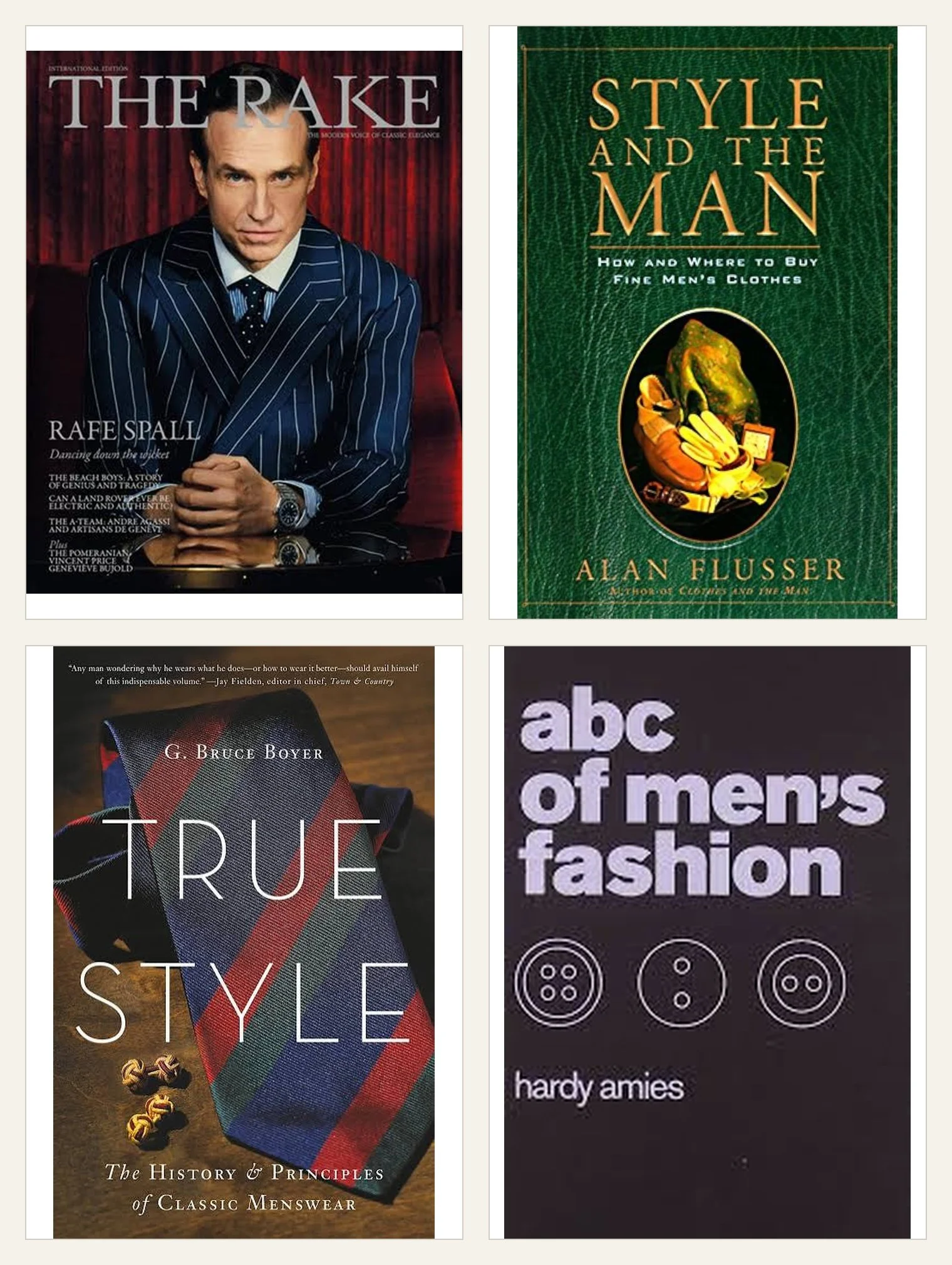
The Rake : Still the benchmark for serious menswear journalism. The Rake covers classic tailoring, heritage fabric mills, and the culture surrounding bespoke and made-to-measure clothing with a depth and specificity built up over years. What the reader may enjoy about this magazine beyond the content itself is the quality of its production. The pages are heavy and the layouts and imagery are beautifully presented.
Style and the Man by Alan Flusser: Decades after its publication, this remains one of the clearest, most thorough explanations of classic men's dress ever written. Flusser does not just tell you what looks good. He explains why, breaking down proportion, silhouette, and the logic behind traditional tailoring and styling - providing the reader with a genuine framework and illustrations to facilitate understanding and an appreciation for the art.
True Style and Elegance, by G. Bruce Boyer: Boyer is, alongside Flusser, one of the great American authorities on classic dress, and his writing has a warmth and erudition that make the history genuinely enjoyable to read. True Style in particular traces where the conventions of men's clothing actually came from. This is useful knowledge for anyone who wants to know why a rule exists before deciding when to break it.
ABC of Men's Fashion, by Hardy Amies: A book that comes directly out of the Savile Row tradition, a true primary source. Amies was a working Savile Row couturier, dressmaker to the Queen no less, and his book is organized as a brisk, opinionated alphabetical guide. It is the closest thing on this list to hearing the tradition speak in its own authentic voice.
Permanent Style: Simon Crompton's website is the closest thing the online menswear world has to a serious, sustained body of criticism. Crompton writes about bespoke tailoring, cloth, and craftsmanship with the kind of specificity that a general-purpose search simply cannot surface. He names cutters, compares houses, and explains construction choices in fine detail. His vision is a modern and current vision informed by the classics.
Style Icons: The Duke of Windsor, Gianni Agnelli, and Cary Grant: Much of this tradition comes from Europe, and it is worth studying at the source. The Duke of Windsor all but invented modern menswear convention, including the Prince of Wales check, the willingness to mix patterns with confidence, and the deliberate softening of a stiff Edwardian silhouette. He wrote about it himself at length in his 1960 memoir A Family Album. It is a genuinely useful primary source, offering an insider's account of why he favored certain cuts, tailors, and fabrics straight from the man responsible for them. Gianni Agnelli, the Italian industrialist, took that same traditional foundation and made a case for personal signature within it, known for sprezzatura, he famously let the narrow tail of his tie hang longer than the wide front blade, or left the knot slightly askew. His watch was worn over the cuff, and he refused to be overly matched. Cary Grant, working from the American side of the same classic vocabulary, remains the standard for elegant restraint in a suit. His look featured nothing showy and nothing to spare, with every proportion doing exactly what it should. Three men, three countries, all working from the same foundation, which is exactly why they reward close study side by side.
Designers Worth Studying: Menswear and Womenswear Side by Side: It's worth looking at designers on both sides of the aisle, since the underlying questions of cut, proportion, and construction don't really respect that divide. On the menswear side, Ralph Lauren and Giorgio Armani represent two very different points of view. Lauren built an entire American vision of old-money, WASP-inflected luxury - tweed, tattersall, the country-club and the Ivy League wardrobe reimagined as aspirational lifestyle - and accomplished an amazing feat: to turn a specific menswear sensibility into a coherent, desirable world. The look was invented 208 years ago by Brooks Brothers but greatly improved by Ralph Lauren 149 years later under the Polo moniker. Armani, working in Italy around the same period, moved in the opposite direction: unstructuring the suit, softening the shoulder, letting the cloth move with the body instead of holding its shape. One built a heritage; the other rewrote the silhouette.
It's worth pairing them against two of the great names in womenswear, Balenciaga and Halston. Because their genius was often about two very different approaches to structure, Balenciaga's engineered volume vs. Halston's minimal drape. Cristóbal Balenciaga approached clothing almost as architecture, engineering shape and volume around the body with a precision that tailors still study for what it reveals about proportion and construction, even outside a womenswear context. Halston, working in America in the 1970s, pursued the opposite instinct: minimal seaming, body-conscious ease, clothes that draped rather than constructed. Both beautiful, but sought after by entirely different consumers.